

Concepts
Felix is a managed agents harness you run yourself. You describe an agent declaratively; Felix compiles that description into a governed, observable, resumable runtime and serves it over several protocols at once.
The through-line is: the manifest is the program, and everything else is machinery that enforces it.
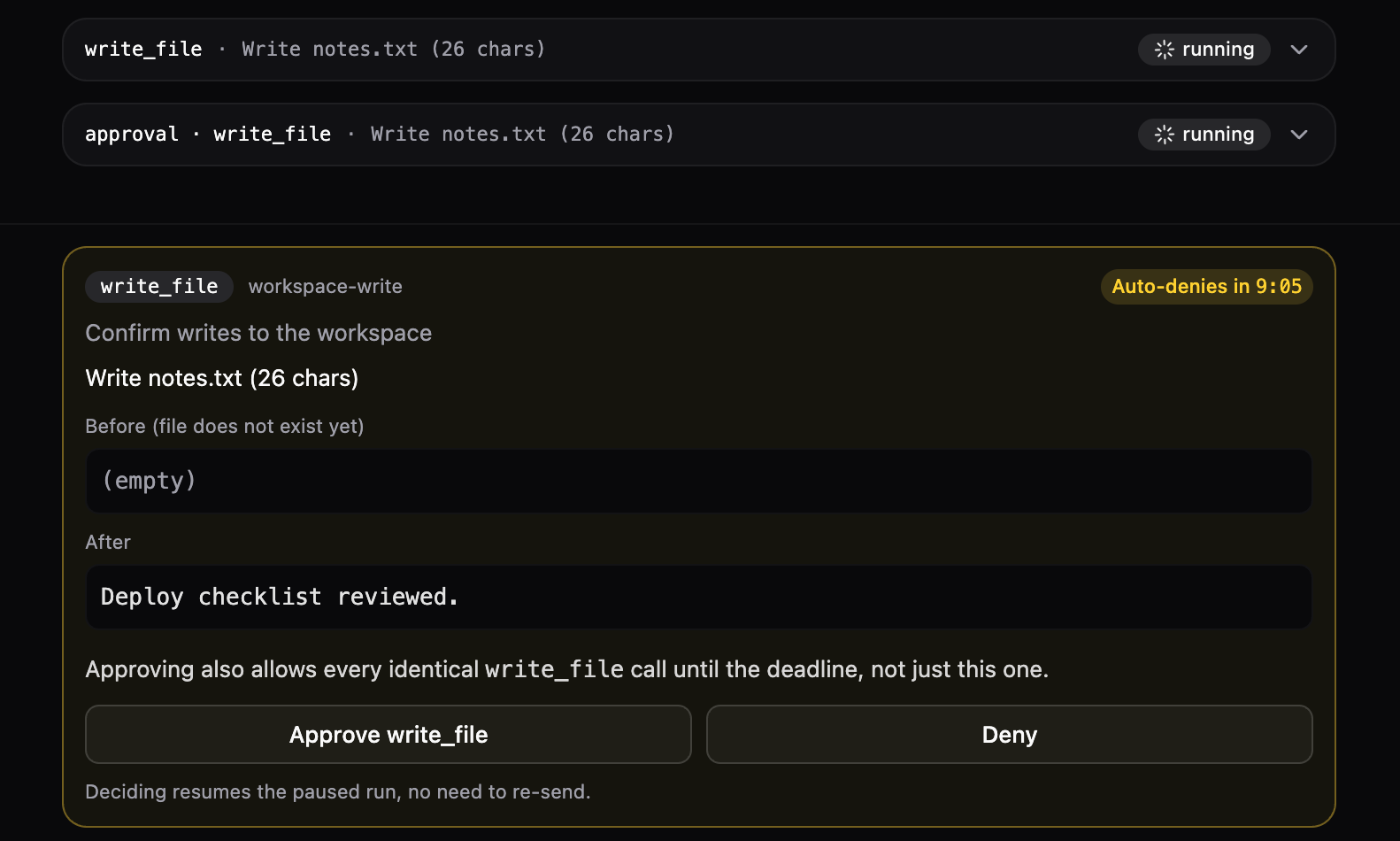
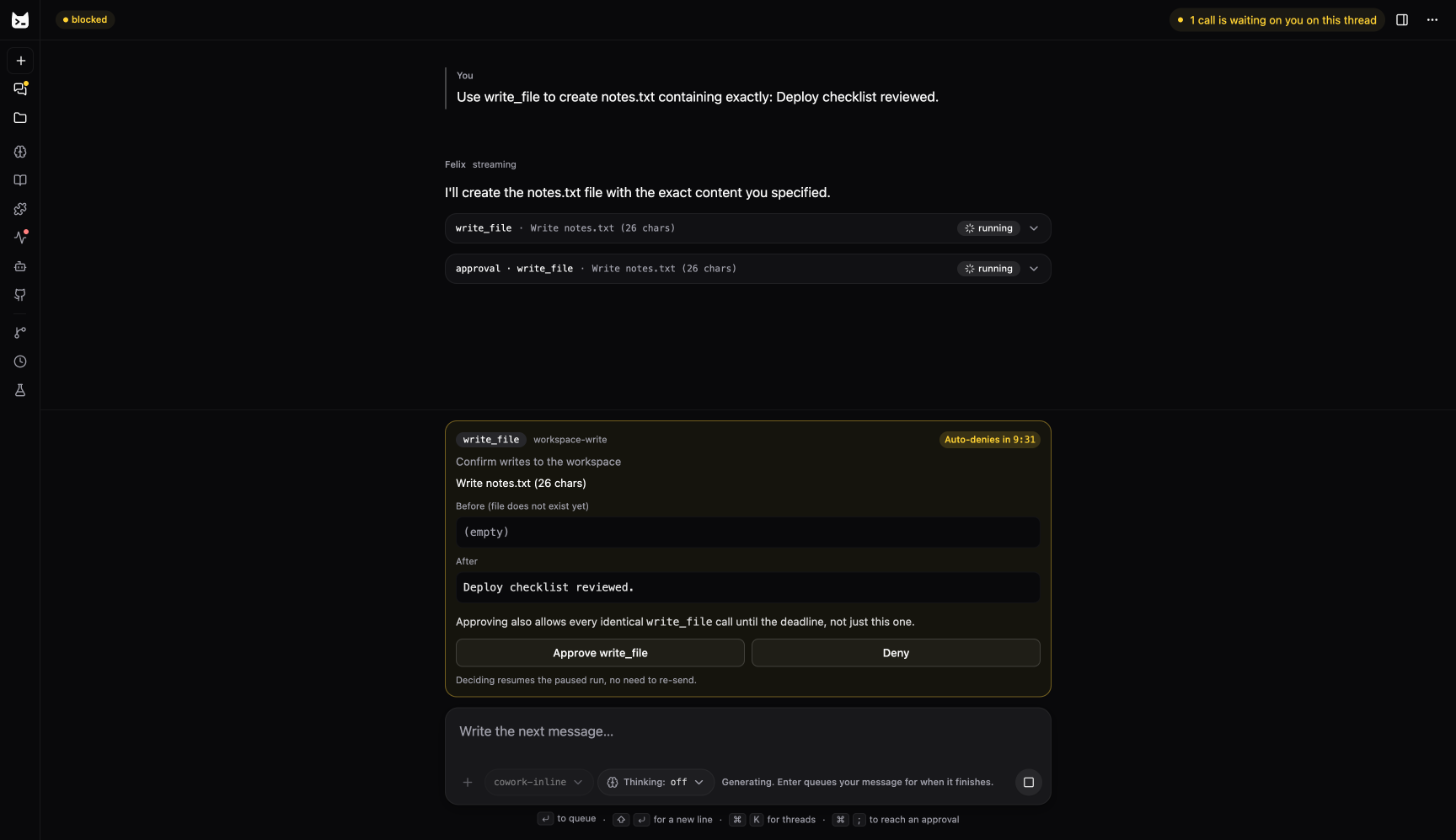
A run paused on a gated write_file, as chat-ui draws it: the file as it is and as
it would be, the deadline after which the harness denies it, and what approving grants. Cropped
from a capture against a local harness (v0.11.2); the call was denied. Full window.
Manifest
Section titled “Manifest”A YAML or JSON document with apiVersion: felix/v1 and kind: Agent. The schema is Pydantic v2 with
extra="forbid", so an unknown key is a hard error rather than a silently ignored typo.
A manifest declares everything an agent needs: pattern, model, system prompt, tools, skills, MCP servers, A2A peers, client tools, memory backend, session strategy, auth requirements, policies, limits, guardrails, screening, approvals, and framework governance.
apiVersion: felix/v1kind: Agentmetadata: name: quickspec: pattern: react model: id: claude-sonnet tools: [calculator]Every field is catalogued in the Manifest reference.
Where manifests come from
Section titled “Where manifests come from”The request-path resolver walks four layers and returns the first hit:
- Tenant Postgres — the tenant’s active pointer (
source: tenant_postgres) - Tenant object store —
manifests/{tenant_id}/{name}.json(source: tenant_object) - Global object store —
manifests/{name}.json, affecting every tenant (source: global_object) - Bundled — the YAML shipped in the image (
source: bundled)
So a tenant manifest named quick shadows the bundled quick for that tenant alone. Active pointers
are cached for 30 seconds. Ten manifests ship in the box: quick, assistant, deep, router,
oss-only, hybrid-router, support, decider-support, cowork and governed. assistant is
quick with long-term memory — see Memory.
contributor and triage, the agents that build Felix itself, are in the image but not bundled.
They need the builder stack’s workspace and shell runner, so they live in manifests/self/, and
only a deployment that sets FELIX_MANIFESTS_DIR to that directory serves them;
deploy/docker/compose.self.yml does. Any directory of manifest YAML works the same way, searched
after the bundled set. A directory that is missing, or that holds a name the bundled set also has,
is refused at boot rather than letting one shadow the other.
FELIX_MANIFEST_SOURCE=bundled collapses that to one layer: only the manifests baked into the
image are served, no manifest store is constructed, and the write routes are not registered — so
the verbs are absent from the app and from /openapi.json rather than present and refusing. It is
the right posture for a deployment that never authors a manifest at runtime. Two things change when
you flip it: every tenant falls back to the image’s file, dropping any per-tenant auth.inbound
tightening, and threads pinned with governance.pin_compile see one 409 as the resolved version
becomes null.
Writes go through the Management API, which is append-only and version-pinned: publishing inserts a new version row and flips a pointer, and rolling back flips the pointer again rather than rewriting content.
Canary rollouts
Section titled “Canary rollouts”An active pointer can carry a canary_version and a canary_weight. Selection is deterministic,
not random — the harness hashes tenant, thread, manifest name and both version numbers, then takes
that modulo 100. A thread therefore stays on one side for the whole rollout instead of flapping
between versions mid-conversation.
Compile pinning
Section titled “Compile pinning”With spec.governance.pin_compile, the manifest version a thread started on is frozen for that
thread. If the active pointer moves underneath a live conversation, the next request fails with
409 rather than silently switching behaviour mid-run.
Tenant
Section titled “Tenant”Every row Felix writes is scoped to a tenant id, taken from the authenticated principal — never
from a request field, so a caller cannot address another tenant’s data. Under
FELIX_AUTH_MODE=none everything is the anonymous principal in tenant default.
Postgres row-level security is available as opt-in defence in depth. The policies themselves are
not optional to install — 0006_tenant_rls is part of the migration chain, so any database at that
revision or later has them. FELIX_DATABASE_RLS is the runtime half: set it true and the tenant
id is applied per transaction and the policy enforces it; leave it false and Felix declares a
bypass, so the policies are inert and query-layer scoping remains the isolation.
One caveat is worth checking rather than assuming, because it fails silently in the direction that
matters: the policies are FORCEd, and a superuser or BYPASSRLS connection skips them
entirely — so RLS can be switched on and enforcing nothing while everything appears to work.
felix doctor reports whether it is actually in effect.
Thread
Section titled “Thread”A thread is one conversation. Its id is always {tenant_id}:{suffix}, where clients supply only the
suffix — a suffix containing : or # is rejected with 400 invalid_thread_id.
Session
Section titled “Session”The session is the append-only event log behind a thread. It lives outside the model’s context window: the log is the durable record, and a strategy decides what the model actually sees each turn.
Event kinds: message, tool_call, tool_result, thinking, audit, compaction,
model_change, thinking_level_change, branch_summary, custom, label, session_info.
Strategies (spec.session.strategy):
| Strategy | Behaviour |
|---|---|
full_replay |
Send the whole transcript. The default. |
windowed:N |
Send the last N events. |
summarizing:N |
Summarize everything older than the last N. |
semantic:N |
Retrieve the N most relevant events (needs the embeddings extra). |
compacting |
Compact on a token threshold, keeping keep_recent_tokens intact. |
Because the log is authoritative and server-side, a client is a view, not the source of truth. It
hydrates from GET /chat/sessions/{id}, whose snapshot carries the transcript, phase, thinking
level, leaf, lease state and any queued steering.
A session moves through phases idle, turn, compaction, branch_summary, retry and aborted.
Branching
Section titled “Branching”A thread is a tree, not a line. Fork copies a session into a new thread up to a chosen event.
Rewind moves the active leaf back to an earlier event in the same thread; unless you opt out, the
abandoned branch is summarized into a branch_summary event so the model does not lose what happened
there.
Editing a sent message is the same move followed by a send. Chat UI rewinds the leaf to the event the message continued from, then sends the new text, so the edit becomes a sibling of the original. The model sees the conversation as if the original had never been sent, while the original and its replies stay on the session on the other branch, which is why the edit can be undone.
Leases
Section titled “Leases”Two browser tabs on one session would race. Each client mints a holder id and takes a lease. One
client holds it exclusive and drives the thread (reported as locked); any number hold it shared
and watch read-only (reported as attached), each with a token of its own. Contention returns 409
for an exclusive acquire only: a shared one always succeeds, with held_by_other: true when
someone else is driving. Observers never block an exclusive acquire and are never promoted, so a
watcher that wants to drive takes the exclusive hold itself once it is free. A client that presents
its token on a write (X-Felix-Lease-Token) is refused unless it is the driver’s — see
Leases. Leases are Redis-backed, so they hold across replicas.
Pattern
Section titled “Pattern”The pattern is the control loop. Felix ships seven:
| Pattern | Kind | Behaviour |
|---|---|---|
react |
single | Think → call tools → observe → repeat. The workhorse. |
deep |
single | Plans first, records steps as a plan document, then executes. |
reflect |
single | Generates, critiques against criteria, and retries below threshold. |
plan_execute |
single | Separate planner and executor models. |
router |
multi | Classifies the request and delegates to one sub-agent. |
parallel |
multi | Fans out to sub-agents and aggregates. |
groupchat |
multi | Sub-agents converse to a joint answer. |
The registry is open — register_pattern(name, builder) adds your own, and nothing in core
enumerates the built-in list. Multi-agent patterns require sub_agents and reject the direct
outbound blocks (peers, containers, queues, sandboxes, browser_tools); a sub-agent’s own
manifest declares those instead. See Patterns.
An Agent Skill: a SKILL.md with YAML frontmatter (name,
description, and optionally license, compatibility, metadata, allowed-tools) and a Markdown
body, plus optional bundle files under references/, scripts/, assets/ and evals/.
Skills are disclosed progressively. The compiled system prompt carries only the catalog, as an
<available_skills> block of names and descriptions. activate_skill returns a skill’s body to the
model as instructions, and lists its bundle files; read_skill_file(name, path) reads one (text
only, at most 64 KiB, with a truncated flag). deactivate_skill switches one off. Activation is
per (tenant, manifest) and only reaches skills in the manifest’s catalog.
Where skills come from
Section titled “Where skills come from”| Source | Where | source |
Written by |
|---|---|---|---|
| Bundled | the harness’s skills/ directory |
bundled |
the release |
| Host directory | FELIX_SKILLS_DIR |
bundled |
the operator |
| Operator upload | object-store keys skills/{tenant}/{name}/SKILL.md or skills/{name}/SKILL.md, and pinned …/{name}/{version}/SKILL.md |
store |
the operator, outside Felix |
| Tenant library | the live version of each skill in the tenant’s library, under skill-library/ |
library |
an agent, an operator, an import from GitHub, or a promotion from a personal library, through review |
| Personal library | the live version of each skill in the caller’s own library, under skill-library/{tenant}/~{digest}/ |
library |
the caller, or an agent under spec.personal_skills: write |
A catalog is built in this order, and the first source to hold a name answers it:
- The host wins. Bundled skills, then
FELIX_SKILLS_DIR(a skill there replaces a bundled one of the same name). The library refuses to save a host name, or a name an operator uploaded at an unversioned key (409 name_shadows_host_skill). - The caller’s own library, live versions only, where the manifest sets
spec.personal_skills: read. A caller with a verified identity has a personal library; an anonymous caller, or an API key with no subject of its own, has none. A personal skill shadows a tenant skill of the same name for that caller alone, and only an ambient one: a name the manifest declares inspec.skillsalways resolves from the tenant’s library. In the web UI it is My skills on the Skills page (?lib=me): the same list, editor and version actions as the team library, published by its owner through the same gate with no review queue — writing needsskills:personal— and a version once published can be promoted into the tenant library as a draft for its review queue. An administrator finds everyone’s under Personal libraries on the team library, listed only when they ask because each listing is audited, and opens one read-only (?lib=<digest>): readable and archivable, with no editor, decision, rollback or promotion. - The tenant library, live versions only. Without
spec.skills_declared_only, every live library skill joins the catalog of every manifest in the tenant that builds one (any manifest withspec.skills, a skill tool, orspec.skill_authoring); with it, only declared names do. - Operator uploads, for a declared name nothing above holds: pinned key, then unversioned, the tenant’s keys before the shared ones.
One exception to library-before-uploads: an explicit version pin to an operator upload beats the
library. A spec.skills ref with version: 0.1.0 is served skills/{tenant}/{name}/0.1.0/SKILL.md
(or the shared skills/{name}/0.1.0/SKILL.md) when it exists, whatever the library’s live version
is. A pin no upload holds still gets the library’s live version. The library reports
shadows_operator_upload on a skill whose name is split this way.
A personal library belongs to one principal within one tenant, and only its owner’s turns load
it. The owner saves and publishes in it through
/skill-library/~me with the skills:personal scope,
through the same publish gate as the tenant’s library but without its review queue; an agent writes
to it under spec.personal_skills: write. Promotion proposes a version the owner has published
to the whole tenant: its files are copied, byte for byte, into a draft of the tenant’s skill of the
same name (source: promoted) that waits in the tenant’s ordinary review queue. Promotion never
publishes, and the draft is judged as strictly as an agent’s draft: the copy rule runs on it, only
its bundle’s own evals/ count toward an evaluation requirement, and it may not add, change or drop
an evals/ file. The personal skill stays as it was.
Skills an agent writes
Section titled “Skills an agent writes”A manifest with spec.skill_authoring.enabled
gets three more tools:
| Tool | Arguments | Does |
|---|---|---|
create_skill |
name, description, body, reason |
Saves a new skill to the tenant library at 0.1.0 (to the caller’s own under spec.personal_skills: write) |
update_skill |
name, body, reason, parent_version, description? |
Saves a new version with a new body; every other file is kept from the parent |
submit_skill_feedback |
name, body, suggested_patch? |
Files feedback on a library skill in this agent’s catalog; changes nothing |
parent_version is required and must be the skill’s newest version that was not a rejected draft
(newest_version in list_skills and activate_skill). A stale one is refused parent_changed;
naming a rejected draft is refused parent_rejected. Because it is an argument, an approval of the
call binds it. Every refusal comes back to the model as {"error": …}.
Drafts are the default. activate_skill hands a body to the model as instructions — a higher
trust tier than recalled memory, which is fenced as reference. A skill an agent wrote from a turn
that carried injected tool output would otherwise steer every later session in the tenant. So a save
is an immutable draft that no catalog loads, and a person publishes it.
-
Draft — the save is validated, quality-reviewed (a 0–100 score) and security-scanned (
pass,advisoryorfail), and written as a new semver version.max_pendingcaps one manifest’s undecided drafts. -
Review — an operator reads it in the review queue (
GET /skill-library/-/review) and publishes or rejects it with a note. -
Publish — the publish gate re-reads the bytes against their saved digests, re-validates and re-scans them, and applies the publish policy. The version becomes
live_version; the one it replaces is archived. A rollback makes a once-published version live again.
spec.skill_authoring.mode: publish skips step 2: the draft is published at once if the gate passes,
and stays a draft (with the reasons) if not. The manifest is refused unless an approvals rule gates
every create_skill and update_skill call, so a person still reads each skill before it is saved.
An agent’s edit of a version an operator wrote, imported or promoted waits for review in either mode, as does an edit built on such a version through drafts nobody has decided yet.
Skills from GitHub
Section titled “Skills from GitHub”An operator can import a skill published on GitHub into the library (felix skills add github:owner/repo/path). The import is a draft pinned to one commit of the repository’s own
history, and it is published like any other, after review. Nothing resolves a GitHub ref when a
manifest compiles.
Imported text is a third party’s, so it stays marked as such: the version and everything built on it
carry lineage_import until an operator adopts a version, the publish gate blocks it on an
advisory scan whatever the policy says, the catalog and list_skills mark it untrusted, and
what the skill tools relay of it is content-screened — at least by the injection markers even where
the manifest turns screening off. A deployment allowlists the repositories each tenant may name, and
can hold back files Felix first saw too recently. Skill import has the whole
surface.
Evaluations and feedback
Section titled “Evaluations and feedback”An evaluation asks whether answers get better with the skill. The worker answers each scenario
twice with FELIX_SKILL_EVAL_MODEL, without the skill and with its body fenced as untrusted
reference; FELIX_SKILL_EVAL_JUDGE_MODEL scores both 0–100, and uplift is with-skill minus
baseline. Scenarios come from the bundle’s evals/, else are generated from the SKILL.md, else are
three defaults built around the description. The publish policy can require a succeeded evaluation
(require_eval) and a minimum uplift (min_eval_uplift). Each evaluation says whether it
counts_for_gate: for a version an agent wrote, only one on the bundle’s own evals/ scenarios
counts, because generated and default scenarios are written from the agent’s own text.
skill_authoring.auto_eval queues one for every draft the agent saves.
Feedback is filed by an agent (submit_skill_feedback) or an operator, on one version, and waits
as pending. Only a person decides it. Accepting with improve (the default) queues an AI rewrite:
the worker asks FELIX_SKILL_IMPROVE_MODEL for a revised SKILL.md and saves it as a draft for
review. Nothing in the loop publishes. Evaluations and improvements run in the worker’s skill_jobs
task, so they need felix-worker and felix-scheduler running.
chat-ui’s Skills page is the operator surface over all of this: the library list, a review queue and
feedback inbox, the tenant’s publish policy, and for each skill its versions with diffs, the gate’s
verdict, evaluations and feedback. Every publish confirm states the gate’s verdict before it asks.
A skill is edited in the side pane, beside the skill’s own page or a conversation: Edit on
its page, Edit to fix on a draft the gate refused, and New skill all open it there, and an
unsaved edit survives switching tabs or moving between pages. A create_skill or update_skill result renders in the
chat as a proposal card with Publish, Reject and Edit. The routes underneath are in the Management API.
chat-ui’s View setting (in the header menu, or /view) has three levels. Everyday is the
conversation and what waits on you. Harness view adds the harness pages — Skills, Activity,
Memory and the rest — to the sidebar, along with the run instrument, the context meter and each
reply’s token counts. Harness + debug (or /debug) adds the instrument’s Debug tab, the event
ids under each turn and tool card, and tool input and output left open. In Everyday, the sidebar
shows a Skill drafts row only while a draft is waiting for review, which links straight to this
page.
Every tool, wherever it runs, is compiled to the same interface and tagged with a transport that shows up in audit rows:
| Transport | Runs where | Declared by |
|---|---|---|
local |
In the API process | spec.tools |
mcp |
A remote MCP server | spec.mcp_servers → {server}__{tool} |
a2a |
Another Felix peer | spec.peers → peer__{name} |
container |
An HTTPS container gateway | spec.containers |
sandbox |
A Docker sandbox (sandbox extra) |
spec.sandboxes |
browser |
Playwright (browser extra) |
spec.browser_tools |
queue |
A separate consumer, via a Redis list | spec.queues |
client |
The caller’s own machine | spec.client_tools |
Tool failures come back as strings the model can read and react to, prefixed
[error/invalid_arguments], [error/timeout], [error/blocked] or [error/internal]. A ref with
fatal: true aborts the batch instead.
Client-executed tools
Section titled “Client-executed tools”spec.client_tools inverts the usual direction: the harness emits a tool_request frame and
blocks, and the browser or CLI runs the tool and answers with POST /chat/tool_result. This is a
real round trip inside the model loop — a client that never answers stalls the run until the tool’s
timeout. It is how the web clients run local shell commands and open local files against a workspace
the server cannot see.
Queue tools
Section titled “Queue tools”A queue tool pushes onto a Redis list and returns immediately; a separate consumer does the work and
writes the result back with POST /internal/sessions/{session_id}/events, authenticated with
X-Felix-Consumer-Secret. Use it for work that outlives a request.
Governance
Section titled “Governance”Every tool is cloned through a fixed wrapper stack before the model can call it. The order is load-bearing and enforced by tests:
secret masking → policies → command screening → content screening → limits → guardrails → judges → approvals → permission mode → artifact spill
| Layer | Manifest block | Question it answers |
|---|---|---|
| Secret masking | — | Is a resolved credential about to leak into output? |
| Policies | spec.policies |
Does the caller hold the scopes this tool requires? |
| Command screening | spec.command_screening |
Is this command allowed, denied, or does it need a human? |
| Content screening | spec.content_screening |
Is this tool output trying to hijack the model? |
| Limits | spec.limits |
Has this run exceeded its budget? |
| Guardrails | spec.guardrails |
Does the text match a blocked pattern (e.g. PII)? |
| Judges | spec.guardrails.judges |
Does a model score this as acceptable? |
| Approvals | spec.approvals |
Has a human said yes? |
| Permission mode | spec.permissions |
Does this conversation’s mode (plan, accept edits, bypass) let it run, or waive its approval? |
| Artifacts | spec.artifacts |
Is this output too large to put in context? |
A denial is stamped with a module-private marker, so a model cannot forge one by emitting a convincing-looking string. Governance fails closed — a missing store or an internal error denies rather than allows. See Governance.
spec.governance.frameworks additionally maps a manifest onto soc2 or eu_ai_act requirements and
refuses to compile without the corresponding controls. That is a compile-time check, not a
certification.
Memory
Section titled “Memory”Two independent things share the word.
Session memory is the transcript, above — the checkpointer (spec.memory.checkpointer, Postgres)
plus a strategy.
Durable memory is facts that outlive a thread. With spec.memory.capture.enabled, a small model
extracts facts from each turn into memory_vectors (pgvector, HNSW) under kinds fact, event,
instruction and task. Stored facts reach a ReAct agent as a prelude at the start of each run, and
spec.memory.recall.tools adds remember, recall, forget and list_memories.
spec.procedural_memory recalls stored how-tos and adds a remember_procedure tool.
Durable memory is keyed by tenant and manifest, not by caller: everyone who talks to one
manifest in one tenant shares its facts. That is why quick stays stateless and the bundled
assistant manifest — quick plus capture, recall tools, content screening and an approval on
forget — sets auth.inbound.allow_anonymous: false. Under FELIX_AUTH_MODE=none every caller is
anonymous, so assistant answers 401; call it with an API key or JWT.
Recall fuses a full-text channel, topic keys and a vector channel. The vector channel runs when
FELIX_MEMORY_EMBEDDER resolves to an embedder: the default auto uses the local
bge-base-en-v1.5 model when felix-harness[embeddings] is installed and runs without the vector
channel otherwise. See Embeddings. Semantic session strategies and
tools_retrieval also need the embeddings extra.
Durable execution
Section titled “Durable execution”By default a run lives and dies with the request. With spec.execution.mode: durable, POST /chat
enqueues a fiber and returns 202 with a resume_token; the fiber checkpoints into Postgres and
a worker picks it up within about a second and resumes it after any restart, so a process restart
does not lose the run. Poll
GET /chat/runs/{resume_token} for the result, or name endpoints in spec.execution.webhooks and
the worker POSTs the finished run to them, signed.
POST /chat/stream on a durable manifest streams the run — run_accepted, run_status, final —
and a dropped client reattaches with the resume token rather than losing the run.
Steering
Section titled “Steering”A run is not a black box once it starts. POST /chat/steer with kind: "steer" interrupts the
remaining tool batch mid-run — or, sent while the thread is idle, is held and delivered at the start
of its next run; kind: "follow_up" queues a message delivered once the run goes idle.
POST /chat/abort stops it, and POST /chat/continue picks it back up with no new user message. The
queues are Redis lists, so any replica can accept the steer.
Neither queue can be read back or withdrawn once a message is in it, so the web client does not put one there by default. A message written while a run is going waits in the tab, above the composer, and is sent as the next turn when the run finishes. Until then it can be edited, reordered or removed, or sent into the run as a steer from its own row. Stopping a run, or a run that fails, pauses that queue, and nothing more is sent until you resume it.
Interrupts
Section titled “Interrupts”Three things pause a run until something answers out of band: an approval_required frame waiting on
a human decision, a tool_request frame waiting on the client, and a ui_request frame asking the
user to choose, confirm or type something. Each has a timeout and fails closed. See
sticky interrupts. The card at the top of this page is an
approval_required waiting on a decision, as chat-ui draws it.
Surfaces
Section titled “Surfaces”The same compiled agent is reachable four ways, which is the point of compiling from a manifest rather than wiring a framework by hand:
| Surface | Entry point |
|---|---|
| Native REST + SSE | POST /chat, POST /chat/stream |
| OpenAI-compatible | POST /v1/chat/completions (model = manifest name) |
| A2A JSON-RPC | POST /a2a |
| MCP | POST /mcp |
Three modes, set by FELIX_AUTH_MODE:
none— everything is anonymous in tenantdefault, and management scope checks are skipped. Legal only on a loopback bind; the harness refuses to start otherwise, in every environment.api_key—Authorization: Bearer,Authorization: ApiKeyorX-Api-Key, compared in constant time againstFELIX_AUTH_API_KEYS, which supplies the subject, tenant and scopes.jwt— verified againstFELIX_JWT_VERIFIERSandFELIX_JWKS_PUBLIC. Mint tokens locally withfelix mint-jwt.
A manifest adds its own inbound requirements through spec.auth.inbound — allow_anonymous and
required_scopes are enforced per request. Management routes layer scopes on top; see
Scopes. A second credential,
X-Felix-Consumer-Secret, gates POST /internal/*.
Details in Auth.
Observability
Section titled “Observability”Prometheus metrics at GET /metrics, counters prefixed felix_*. Audit rows are buffered by the
process that emits them and flushed
to Postgres on a timer plus a drain on shutdown — the agent loop runs in the API process, so the API
flushes too, not only the worker. Optional OTLP tracing with FELIX_OTEL_ENABLED, and an optional
append-only analytics spill (FELIX_WAREHOUSE: DuckDB, ClickHouse or Doris).
See Observability.
Three seams
Section titled “Three seams”- Session — append-only events with pluggable strategies (
full_replay/ windowed / summarizing / semantic / compacting). - Pattern / model registries — open registration for loops (
react,deep, …) and providers (anthropic,openai,workers_ai,groq, …), with the model layer in its own package that cannot import the harness. - ToolExecutor —
local/mcp/a2a/container/queue/sandbox/browser/client, wrapped by governance.
Request lifecycle
Section titled “Request lifecycle”Putting it together, one POST /chat:
-
Middleware — request id, then body limit (1 MiB; 12 MiB on the two skill-library routes that carry a whole bundle), then per-tenant rate limit, then authentication. All four are pure ASGI, so a streamed response is not copied between layers.
-
Resolve — walk the four manifest layers, pick the canary variant, check the compile pin.
-
Authorize — apply
spec.auth.inbound; screen the inbound user turn. -
Compile —
build_agentresolves the prompt and sub-agents, binds outbound tools, wires skills and memory, and wraps every tool in the governance stack. -
Run — the pattern loop calls the model and dispatches tools, emitting audit rows and stream frames, and pausing on any interrupt.
-
Persist — append events to the session log; buffer audit and usage for flush.
For the mechanism at each step, start at Architecture.